As the summer begins to draw to a close, Issue Four of The Lawkit hit 'the shelves' of the internet today. Initially I had decided not to contribute, but ended up with something wholly suitable more or less by accident. (A blog post which was far too long, essentially.)
I chose to write in this issue about narrative and storytelling, and the crucial role I believe it plays in humanity's essence. Funnily enough, I was about to write a few lines here about something completely different, but an obvious link was prompted in my mind.
I'm currently up in the tower, cutting away at footage from Monday's Refresh Belfast event in the Black Box - an event that went almost went pretty flawlessly. I'm pleased with how the raw footage looks (believe me, I would not mention it, even in this small corner of the internet, if I wasn't, and particularly not pre-release).
However, gremlins do rear their head; though freshly charged and thoroughly tested, the speaker's nifty headset mic decided to fall over half-way through. Not a problem, as we had a spare beside him, ready to go - barely a stumble in the live sense.
However, in the video and out of that context, I'm presented with an editing dilemma. Here's the sequence of events: speaker pauses; begins to make his next point; mic crackles a bit and dies; speaker looks a little confused; speaker is handed a fresh mic; speaker continues, more or less exactly where he left off.
The obvious thing is just to cut the incident out completely, right? And join up the two ends? But this is where my loyalty to narrative kicks in.
Crucially, in a visual sense, things have changed: the speaker now has a mic in his hand, and is seated in a slightly different position. There's no match cut; instead, there's a fairly clear jump in positions which jars. So whilst you don't lose anything content wise - there's nothing to lose - something is different.
My inclination in these situations has become to leave the incident in - to inform the viewer why things have changed. (See, for example, the mildly infamous 'Chris groping Tim Van Damme' moment from Build last year - and it wasn't even our equipment he was fixing!) This may seem unnecessary. However, I feel it actually helps with the 'story' that's being told. Rather than a viewer spending a couple of minutes puzzled by the jump cut, and thereby potentially being distracted from the narrative that's being told, they walk through alongside the teller. No confusion, no distraction - just a little incident, right?
---

Wednesday, 24 August 2011

Tuesday, 9 August 2011
a forfey postcard
Featuring a sign, some sunflowers, the cows, a load of tents, Adam Currie and his Yaschia 635, wellies, microphones, More Than Conquerors, Farriers, Wondervillains, Rams' Pocket Radio, a brace of trout, printing, Andy and Old Toby, a crowd, Kasper Rosa, Katie & The Carnival, Duke Special Jr. looking a bit lost, an important sign, some umbrellas, a lot of rain, Feldberg, an interesting choice of headgear, Simon Newell's epic boatmaking skills (tested by Kerry), a double rainbow, a barbeque (before and after), a kid dressed as Spiderman (look carefully), a hipster racoon, a literally knees-up, Master & Dog, Daithí Ó Drónaí, a nice candle, Captain Cameron, and Tim Doak looking slightly bemused at Matt's big head.
Monday, 1 August 2011
Friday, 29 July 2011
call for support
Just had a slightly unusual bit of cold calling - from Tearfund. Or rather, a telesales agency working "on behalf" of Tearfund.
But keep that righteous indignation in check for a minute. Though clearly reading from a script for most of the call, the polite (and noticeably, less aggressive than is typical) lady on the other end did not deliver the usual telesales jargon. She finished the call with:
"Just to make clear, I am working for a company engaged by Tearfund for fundraising, and though we are being paid £24,000 for this contract, Tearfund hope to make £270,000 over the next four years from these commitments."
I did not ask for this information, and it left me with a very different impression than I had, say, mid-call. As an irregular Tearfund supporter, I appreciate being an obvious port of call when the time comes for an appeal, and remain interested in what is going on even if I choose not to support them in this way. For that reason, I listened to her entire pitch before responding (rather than interrupting and ending the call straight away, as I would if she were selling windows/insurance/phones/hovercraft/whatever).
And it leaves an interesting discourse to my mind. I am generally divided over how charities should spend their money. On one hand, I love the fact that some, such as charity:water, guarantee that 100% of public donations go to the causes advertised, committing to pay for admin/operational costs through corporate sponsorship.
On the other hand, for the majority this just isn't possible; as Mrs H and I continue to build towards the potential of a year away next year, I'm only too aware that we will ourselves need to fundraise to cover some of the costs of our missional efforts.
Is it admirable that Tearfund are investing money donated to them in this way, and being so upfront about it? I rather think it might be. But I wonder if others may be miffed that their gifts and donations have not gone straight to the third world. We humans are funny like that.
But keep that righteous indignation in check for a minute. Though clearly reading from a script for most of the call, the polite (and noticeably, less aggressive than is typical) lady on the other end did not deliver the usual telesales jargon. She finished the call with:
"Just to make clear, I am working for a company engaged by Tearfund for fundraising, and though we are being paid £24,000 for this contract, Tearfund hope to make £270,000 over the next four years from these commitments."
I did not ask for this information, and it left me with a very different impression than I had, say, mid-call. As an irregular Tearfund supporter, I appreciate being an obvious port of call when the time comes for an appeal, and remain interested in what is going on even if I choose not to support them in this way. For that reason, I listened to her entire pitch before responding (rather than interrupting and ending the call straight away, as I would if she were selling windows/insurance/phones/hovercraft/whatever).
And it leaves an interesting discourse to my mind. I am generally divided over how charities should spend their money. On one hand, I love the fact that some, such as charity:water, guarantee that 100% of public donations go to the causes advertised, committing to pay for admin/operational costs through corporate sponsorship.
On the other hand, for the majority this just isn't possible; as Mrs H and I continue to build towards the potential of a year away next year, I'm only too aware that we will ourselves need to fundraise to cover some of the costs of our missional efforts.
Is it admirable that Tearfund are investing money donated to them in this way, and being so upfront about it? I rather think it might be. But I wonder if others may be miffed that their gifts and donations have not gone straight to the third world. We humans are funny like that.
Tuesday, 26 July 2011
back to the grind
Back in Box42 HQ after a couple of (long) weeks on the road this week; between Summer Madness and New Wine, an awful lot of sleep has gone missing somewhere!
In fact, even though we got back from NWI over a week ago, I'm still recovering. So rather than a lengthly discourse on good times had, here's Story House's cracking video from SM of Rend Collective hammering out their new version of a much-loved hymn. (Which we, of course, contributed to - a whole tripod... where's our royalties, Chris?)
In fact, even though we got back from NWI over a week ago, I'm still recovering. So rather than a lengthly discourse on good times had, here's Story House's cracking video from SM of Rend Collective hammering out their new version of a much-loved hymn. (Which we, of course, contributed to - a whole tripod... where's our royalties, Chris?)
Thursday, 23 June 2011
award! award!
 It's not quite a Golden Cleric, but to some amusement, the Valley of Angels team sidled out of the Bangor Business Awards on Monday night past as recipients of the Best Creative Industries Award.
There's a bit of explaining required here. The inaugural Valley of Angels festival took place in Bangor, Co. Down, at the start of May. There's a lovely website which can explain a lot more about it in particular, and is worth your time for the music videos alone. But then I would say that, as I put them together,
The festival, conceived by audio overlord Les Hume (of EMS Audio and Dawson's Music, both in Bangor) was hauled into shape in as little as two months. For us (that is, Box42) Andrew and myself got stuck in as well to try and cover as much promotional and technical ground as possible. The resulting weekend went well, and all were very pleased.
However, it was only as yer man off the radio was reading out the judge's (admittedly blown-up) comments at the awards on Monday night that I really sat back and realised just how much had been achieved in the first year. For a start, this wasn't just a music festival - we had arts (the Firsty? Pop-Up Exhibition), schools involved (colour-in competition!) massive engagement from local churches (including Psalmody and the set-piece closing event, where Iain Archer, Captain Cameron et al sent spine-tingling waves throughout the unique, epic confines of Bangor Parish). Not to mention the ice-cream eating contest, or the guided tours, or the visit to the Avalon guitar factory, and so on and so on...
Turns out, we did ok. And more importantly, Bangor seems to want more. It'll be great to see where the Valley of Angels goes next.
Wednesday, 15 June 2011
Tuesday, 14 June 2011
death and dying: terry pratchett's choosing to die
 Across the media this morning, folks are talking, writing and blogging reactions to Sir Terry Pratchett's documentary which aired on BBC2 last night (Monday 13th June.) However, I feel like adding my insignificant two cents, as it is a subject which has always had a profound effect.
Sir Terry, himself suffering the onset of Alzheimer's disease, is personally conflicted. On one hand, he is in favour of the legalisation of assisted suicide in the UK. On the other, on travelling to the Dignitas clinic in Switzerland, he does not see it as a black and white issue.
Terry Pratchett is to me, as to many, a literary and creative hero and inspiration, and this was an compelling piece of film making. Really, you might ask? Well, for example, I believe this could have been a very one sided programme. But rather, I felt that, although he himself clearly had an agenda in making it, the documentary gave a strong voice to both sides of the debate around the morality of assisted suicide. Sir Terry spoke about the horrors of covering suicide as a journalist, and how repulsive he had found it; how he would not wish such an ending on anyone. His PA, Rob, clearly expressed how difficult he found the idea; though loyal to his employer and friend, he came across as strongly opposed to the notion, voicing a clear moral opposition, and from a secular standpoint.
And yet Sir Terry was, himself, exploring and considering his own desire to choose how he should die. Clearly fearful of the loss of his capacity to communicate in particular, he expressed his wish to set and predestine his death. He met others in similar situations; in particular, the charismatic and gentlemanly Peter Smedley, whose death it was which was aired at the climax of last night's programme. In his seventies and beginning to suffer the severe onset of motor neurone disease, he had chosen to complete the Dignitas procedure: we watched as he was examined over the course of a week to ensure that he was capable of making such a decision for himself; as he was asked, repeatedly, if he was sure that he did not want to leave and go back home; and, at the last, as he was allowed to take the two 'medicines' required, and slowly slipped off into a deep sleep as his body was prevented from respirating by the concoction. It was
I don't wish to spend time giving a full airing to both sides of the debate; much of the BBC's airtime on radio and television this AM is dedicated to that, and I commend them for it. (Even Stephen Nolan is currently presenting what is actually a balanced debate on the subject, which must be a first for him.)
But from my own perspective, I struggle greatly with assisted suicide. Dignitas's founder was convinced by the UN Convention on Human Rights that people do indeed deserve to choose how they die: after all, that charter enshrines Article 8: The Right To Self-Determination into law. I then realise that my personal faith contradicts this: in one sense, I have no conflict over the issue, as I do not believe that the moment at which I die is my decision to make, but rather that of the God who made me. And yet even in that, it is not a simple, harsh point to be made.
Most of us have met or know someone who passed away, seemingly confident that they were 'ready to die'. At the funeral of the grandmother of a close friend a few years ago, it was clearly articulated that she had felt she was ready to die for years, as she had suffered a lot of physical pain and exhaustion in later life. Our response to this is one of appreciation: we do not question her statement. And yet we would not offer her the opportunity to decide to do just that prematurely.
There was a fascinating moment last night when Terry Pratchett spoke to a doctor, who was employed by Dignitas to assess the mental capability of clients to make their own decisions. If she had said no, for example, Peter Smedley would not have been allowed to access the toxins required to kill himself. This is reasonably common practice across Western Europe, where in many countries assisted suicide is legal in certain situations. And yet this same doctor articulated that she could never actually administer a lethal dose herself, and that she would be completely morally opposed to it.
Rob, Sir Terry's assistant, kept coming back to his point that as clients at Dignitas had to be mentally and physically capable of kiling themselves, they were therefore all in situations where they usually had many years left to live. Surely, he insisted, did they not want to live those years? When Andrew, a 42 year old man with heavy MS, spoke the day he died of still wanting to explore parts of Zurich, where he had only just arrived, Rob blurted out, "Well, let's go then! Let's go see these places tomorrow," Andrew merely shook his head, resigned to the decision he had made to take his own life instead.
I fear death. I don't think I fear anything as much. That may sound hypocritical from someone who increasingly bangs on about a God so much, but it is nonetheless true. And of all the possibilities for my later years (assuming that I get that far) I don't believe I fear anything more that a death plagued by Alzheimer's, dementia or similar. I feel I would rather be physically incapacitated, but still have my mind, than the other way around. And so I appreciate greatly that a relief, any relief, even the starkest, from this is so tempting for someone in Sir Terry's situation, or in that of any of those featured last night. And yet I know that regardless, with or without faith, I thoroughly believe that we should squeeze as much out of this life as possible. But I cannot currently imagine ever saying I would be 'ready to die'.
And I fear greatly for some of those who would. It was very telling, as Rob told us in last night's show, that according to Wikipedia,
'21% of people receiving assisted dying in Dignitas do not have a terminal or progressive illness, but rather "weariness of life".'Having known some who have attempted to take their own lives in the past, and often the regret they express afterwards, or the battles with depression others have faced, I am terrified of this possibility being available to anyone.
I fear that this is a debate which is growing. I have some confidence that, certainly in my lifetime, some form at least of assisted suicide will be legalised in the UK. I do not know how I will face it if I ever encounter it amongst anyone I know. I am 99.5% against, for moral, spiritual and practical reasons. And yet that 0.5% of pain remains, as my heart goes out to those faced with the possibility of ending their own suffering. We owe it to ourselves to deal with dying better.
In truth, if you or I am opposed to assisted suicide so strongly, we need to make our case: not in words or statements or even articles of religion, but in comforting, in dedication, and in sympathy for those how suffer. How far we are, as a society, from being able to do that, I can only begin to imagine. The vulnerable and the suffering need a reason to keep living, and only we, their fellow humans, can show it to them.
---
Thursday, 2 June 2011
and the rains came
 A couple of weekends ago, a bunch of lads went for a stroll up some big hills in Co. Down. What ensued was an awful lot of being battered and drenched by the elements. But surprisingly, spirits were high throughout the day, night and following morning until we strolled back down again.
Anyway, one of the minor miracles involved was that we managed to navigate our way up and down a new route, despite visibility dropping to... well, very little in places. It's also hard to keep an eye on a (non-existent) horizon when you're struggling just to stay on your feet. So, for the benefit of the other gents, I took a moment the next day to sketch out the route we took. (Original map courtesy of HM The Queen and suchlike, reproduced without permission because she surely wouldn't mind.)
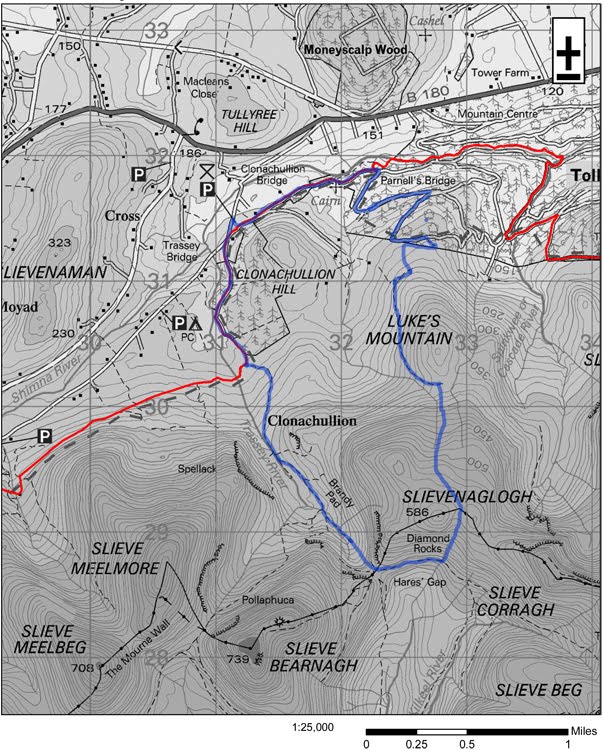
Mr Jonathan Kirk compiled a small Facebook photo album, but you may need to befriend him in order to see it.
Wednesday, 1 June 2011
rod liddle and smug humanists
 Whilst no saint himself, I greatly enjoyed Rod Liddle's column in the Sunday Times a couple of weeks ago.
On the morning after the apolocalypse was predicted to have occurred, Rod's commented on the events surrounding Harold Camping's failed prediction of armageddon. He may have made a couple of disputable points, which are only to be expected: "Yesterday was supposedly the date of the Rapture... according to millions of born-again Christians across the globe..." Errr, no actually, just a highly misled old man from the States and his - albeit large - band of followers. However, his tempered vitriol is reserved for those who sneer from the other side of faith's Great Divide.
I've taken the liberty of transcribing a large portion of his column: obviously, none of it is my own.
Armageddon and smug humanists: as awful as each other
"It will be a slight disappointment to me if yesterday wasn't actually the end of the world, frankly. It would at least wipe the smile off the faces of those jeering humanists who are busy organising ironic pre-Rapture parties. I suppose schadenfreude and spite are poor reasons to yearn for the utter and complete destruction of mankind, but I cannot help myself. I want to watch the look on Dawkins's face when a giant hand comes down and pokes him in the eye, booming, 'Bad call, science boy.'
"There is something insufferably arrogant and aloof about humanism, its presumption that we represent the bes that there is to offer, that there is nothing more powerful than us. Most of the humanists holding parties over the weekend probably still have the trestle tables left over from their hilariously ironic Not The Royal Wedding street parties, and probably some fo the food too (hummus, I would guess... and organic pitta bread.)
"Dig beneath the surface and you'll find that a fair few of the also believe the end of the world is coming, maybe 30 years or so in the future, the consequence of another foreseen Rature, global warming, with its terrible herald of forlorn-looking polar bears marooned on melting icebergs. Floods, famine, pestilence, drought - the prophecies of the global warming movement's militant wing all have an agreeably biblical ring about them, don't you think?
"One way or another there is something inside many of us that yearns for annihilation and is convinced that it is indeed coming very soon, if only the ignorant masses would listen. I suppose it is a form of narcissism, that we have been singled out for special treatment either because of our own piety, in the case of the evangelical Christians, or the ignorance of others, in the case of the global warming millennialists."
Indeed.
Wednesday, 18 May 2011
appetite for destruction
Permit me a short rant.
Lovers of Patrick: The Movie will remember the Patmobile - which, R plates and all, was in fact the Ford Escort Osprey I inherited from the Old Man (he of 60's public indency fame). It was clapped out, it had 235,000 on the clock, and after the water pump went it sat in my mother's yard for a year. As she prepared to up sticks last October, the end was nigh.
So I found a local breaker, and send it off for destruction. I asked if I needed to do notify anyone, and was assured it was all in hand. And, I'll admit, I left it at that.
But apparently, I should have notified the DVA of such things. Which makes sense when you think about it, but I did not. I guess in the same way that, upon buying a car, the new possessor is obliged to fill out the page in the log book and send if off, I assumed that the folks who took the Escort away would do the same. They did not.
And may I add - completing an Out Of Court Settlement with a Visa Debit card just seems wrong.
Lovers of Patrick: The Movie will remember the Patmobile - which, R plates and all, was in fact the Ford Escort Osprey I inherited from the Old Man (he of 60's public indency fame). It was clapped out, it had 235,000 on the clock, and after the water pump went it sat in my mother's yard for a year. As she prepared to up sticks last October, the end was nigh.
So I found a local breaker, and send it off for destruction. I asked if I needed to do notify anyone, and was assured it was all in hand. And, I'll admit, I left it at that.
But apparently, I should have notified the DVA of such things. Which makes sense when you think about it, but I did not. I guess in the same way that, upon buying a car, the new possessor is obliged to fill out the page in the log book and send if off, I assumed that the folks who took the Escort away would do the same. They did not.
And may I add - completing an Out Of Court Settlement with a Visa Debit card just seems wrong.
Monday, 16 May 2011
thank you for giving
Over the weekend, Mrs H and myself finally managed to organise a particularly special delivery.
Upon getting hitched nearly three months ago, we had decided to nominate a particular cause, rather than setting a wedding list. The cause in question was SIM's (Serving In Mission) Hospital in Galmi, Niger, where Ruth had served as an STA in 2008 and 2009. A quick refresher of a few of Niger facts:
- Niger is in central West Africa;
- It is the third least developed country in the world;
- Its main (and frequently, only) export is uranium;
- It is about twice the size of the US state of Texas, is 88% desert;
- it has a recent history of civil war and insurrection.
 Fun times. But despite all of that, Ruth found Niger an truly wonderful and awesome place. As is often the case, behind a few hairy facts lies a welcoming, if harsh, place. In particular, the rural (i.e. it's in the desert) hospital at Galmi is crucial in many ways. For a huge swathe of the country it offers the only real medical support, particularly for any kind of specialist care. Moreover, as a hospital with a strongly Christian ethos, it can provide a level of compassionate care the few others can ill afford, and is able to bring in international doctors to help out.
But to the golden envelope. The point of this post is to say that thanks to the overwhelmingly generous donations of family and friends to mark our wedding, we have been able to give in excess of £2000 directly to Galmi. A fantastic total from some fantastic people, and we would like to take the opportunity to say thank you to all who gave in any way.
So thank you for giving.
Upon getting hitched nearly three months ago, we had decided to nominate a particular cause, rather than setting a wedding list. The cause in question was SIM's (Serving In Mission) Hospital in Galmi, Niger, where Ruth had served as an STA in 2008 and 2009. A quick refresher of a few of Niger facts:
- Niger is in central West Africa;
- It is the third least developed country in the world;
- Its main (and frequently, only) export is uranium;
- It is about twice the size of the US state of Texas, is 88% desert;
- it has a recent history of civil war and insurrection.
 Fun times. But despite all of that, Ruth found Niger an truly wonderful and awesome place. As is often the case, behind a few hairy facts lies a welcoming, if harsh, place. In particular, the rural (i.e. it's in the desert) hospital at Galmi is crucial in many ways. For a huge swathe of the country it offers the only real medical support, particularly for any kind of specialist care. Moreover, as a hospital with a strongly Christian ethos, it can provide a level of compassionate care the few others can ill afford, and is able to bring in international doctors to help out.
But to the golden envelope. The point of this post is to say that thanks to the overwhelmingly generous donations of family and friends to mark our wedding, we have been able to give in excess of £2000 directly to Galmi. A fantastic total from some fantastic people, and we would like to take the opportunity to say thank you to all who gave in any way.
So thank you for giving.
Wednesday, 13 April 2011
lawkit: issue one available now
 From today, you can download or view your own personal copy of the Lawkit from the shiny new (minimalist) website.
It's deliberately published as a PDF. The layout is minimalist but key. This isn't a blog. It's not a cobbled together list of bullet points. Lawkit is centred on the written content, and it is given priority on every page.
I'll be blunt - I'm spectacularly proud of those who contributed effort to the launch issue. Ever since I appealed for contributions a little over a fortnight ago (the lawkit: a call to arms, March 22nd), more than enough people stepped up to the plate, each not really fully knowing what they were getting themselves in to but more than happy to be a part of it.
And what a result. I'm not going to give much away here, but despite having read, re-read and edited all the text content previously, I still sat down for a full read-through this morning and was still gobsmacked. And so, a few thanks to the contributors for Issue One: Andrew Neill, who was first to submit; Jonny Kirk, who produced a piece with exactly the tone we've come to expect from his writing, and on a subject dearly close to his heart which shines throughout; the indefatigable Graeme Smyth, who applied his unique style to great effect (if you know GS, then you will find reading him akin to listening to him pontificating splendidly); and Matt Gamble, who's article was, I'll admit, an easy choice for the front cover - and which, the first time he recounted the anecdote to me, completely blew me away.
And of course, the biggest thanks go to David Lowry, frequently of this parish, for pulling it all together, not to mention hosting the blooming thing. Top notch.
OF COURSE, this is just the start. Now we've done One, we must do Two. And anyone can contribute. See the back couple of pages of the current issue for the necessary information - there's not much to it!
Most of all - please enjoy. This is (hopefully) just the beginning.
Thursday, 7 April 2011
nearly there
It's been a busy couple of weeks, mostly spent working on three separate projects, both in and out of work.
First things first: no, the first issue of the Lawkit is not online. (As you can see.) But it will be soon. Very pleased and excited with the way things have progressed; the text and contents are set, just a few graphical tweaks remain.
Another website still under work, but with much more to look at already, is for the Valley of Angels festival in Bangor next month. It's a fairly unique proposition - bringing together a diverse set of musicians and artists for a mixture of either free or very cheap events in some interesting venues... my pick of the events announced so far are the Avalon Guitars factory tour and the Centre Stage event in the Flagship Centre, both of which are free in. There's also an obscenely large prize in the busking competition on the Saturday. It'll be worth keeping an eye for the Knights In The Round gig, which the line-up has not yet been officially unveiled for. (It's a good one, trust me.)
Of course, though it's great to be so heavily involved in something, I am somewhat gutted that the same weekend sees the quiet visit of Kate Rusby to Belfast as part of the Cathedral Quarter Arts Festival. Having never been able to see Kate live, I would probably have sold my granny to have been there anyway. (In fact, I've just spotted the evening gig is sold out already. There's an afternoon one though.) Kate is, quiet rightly, the first lady of folk music, and an unmissable talent.
Finally, there's an election on - and d'workplace has been no exception when it comes to getting involved. We've got on board with Stratagem to ask some of the biggest observers in Northern Ireland for their thoughts on the past and present of the NI Assembly. The first episode is due online tomorrow - watch d'twitter for that one, no doubt.
First things first: no, the first issue of the Lawkit is not online. (As you can see.) But it will be soon. Very pleased and excited with the way things have progressed; the text and contents are set, just a few graphical tweaks remain.
Another website still under work, but with much more to look at already, is for the Valley of Angels festival in Bangor next month. It's a fairly unique proposition - bringing together a diverse set of musicians and artists for a mixture of either free or very cheap events in some interesting venues... my pick of the events announced so far are the Avalon Guitars factory tour and the Centre Stage event in the Flagship Centre, both of which are free in. There's also an obscenely large prize in the busking competition on the Saturday. It'll be worth keeping an eye for the Knights In The Round gig, which the line-up has not yet been officially unveiled for. (It's a good one, trust me.)
Of course, though it's great to be so heavily involved in something, I am somewhat gutted that the same weekend sees the quiet visit of Kate Rusby to Belfast as part of the Cathedral Quarter Arts Festival. Having never been able to see Kate live, I would probably have sold my granny to have been there anyway. (In fact, I've just spotted the evening gig is sold out already. There's an afternoon one though.) Kate is, quiet rightly, the first lady of folk music, and an unmissable talent.
Finally, there's an election on - and d'workplace has been no exception when it comes to getting involved. We've got on board with Stratagem to ask some of the biggest observers in Northern Ireland for their thoughts on the past and present of the NI Assembly. The first episode is due online tomorrow - watch d'twitter for that one, no doubt.
Wednesday, 23 March 2011
the lawkit contributor's guide
Further to the previous introduction (and as self-elected editor-in-chief) I've taken the liberty of drawing up a few guidelines. Now, traditionally a publication's style guide sets out their rules for language, grammar, formatting and so on. This post is not one of those.
Rather, I want to offer a context and some parameters, which should assist potential contributors in understanding the tone we're going for. In terms of the practical elements of formatting, I'm largely happy to satisfy the English teacher part of me in correcting the small things. The important thing here is to get across the potential style of the publication itself.
I should also mention that some of the ideas here were inspired by this excellent article on A List Apart by Erin Kissane, which the ever-pedantic @djlowry was kind enough to draw my attention to.
THE LAWKIT CONTRIBUTOR'S GUIDE
 - Apparently, you should never read a book by its cover. However, you can tell a lot about the tone of a publication on first look - that's the point of marketing. To that end, the mock-up shown here gives a fair idea of the sort of style currently in the works. Minimalist but striking, letting the content do the talking. I've come up with some multi-coloured nightmares over the last while as I've been thinking about this, but after the epiphany that was the name, the style wrote itself.
- Lawkit should read like a collection of well-written blog posts. Think of your favourite online articles. What makes them so readable?
- The best way to pin down your subject matter is to start with our subject list. To complete an issue, I'd like to gather articles which collectively cover the majority of these. (Potentially, the blog would note which topics were already "taken" for each issue as well.) Currently, the list is:
Politics
Technology
Outdoors
Film
Music
Faith
Science
Sport
Gadgets
Life
- What's the point of Lawkit? It's about Life As We Know It. It's about sharing knowledge. But you don't have to be an expert to write on something, as long as you are interested in it - because if you are interested in something, you'll be interested in telling others about it. To that end, don't try to argue a point you don't believe in.
- Knowledge is king, but knowledge can also be useful. Able to write a How-To guide for something? Then do it.
- Don't be afraid to be specific or niche.
- Be clear about your subject from the start: 500 words and no waffle is highly preferable to 1500 with - and it'll get cut anyway. Slaughter your babies - omit needless content or someone else will.
- If you only have twenty minutes to bang out something, go for it all the same.
- So knowledge is king, but clarity is Grand High Poobah; you can speak a bit academically and still stay accessible to the casual expert. There's nothing more irritating than being obtuse for the sake of it, and you know it.
- This isn't to sell stuff (yet.) So don't do it - unless you're willing to give something in return for advertising (in which case, let's talk.) That said, if you're involved in something that you feel people might like to hear about, please tell us.
Got all that? Then get scribbling.
Rather, I want to offer a context and some parameters, which should assist potential contributors in understanding the tone we're going for. In terms of the practical elements of formatting, I'm largely happy to satisfy the English teacher part of me in correcting the small things. The important thing here is to get across the potential style of the publication itself.
I should also mention that some of the ideas here were inspired by this excellent article on A List Apart by Erin Kissane, which the ever-pedantic @djlowry was kind enough to draw my attention to.
THE LAWKIT CONTRIBUTOR'S GUIDE
 - Apparently, you should never read a book by its cover. However, you can tell a lot about the tone of a publication on first look - that's the point of marketing. To that end, the mock-up shown here gives a fair idea of the sort of style currently in the works. Minimalist but striking, letting the content do the talking. I've come up with some multi-coloured nightmares over the last while as I've been thinking about this, but after the epiphany that was the name, the style wrote itself.
- Lawkit should read like a collection of well-written blog posts. Think of your favourite online articles. What makes them so readable?
- The best way to pin down your subject matter is to start with our subject list. To complete an issue, I'd like to gather articles which collectively cover the majority of these. (Potentially, the blog would note which topics were already "taken" for each issue as well.) Currently, the list is:
Politics
Technology
Outdoors
Film
Music
Faith
Science
Sport
Gadgets
Life
- What's the point of Lawkit? It's about Life As We Know It. It's about sharing knowledge. But you don't have to be an expert to write on something, as long as you are interested in it - because if you are interested in something, you'll be interested in telling others about it. To that end, don't try to argue a point you don't believe in.
- Knowledge is king, but knowledge can also be useful. Able to write a How-To guide for something? Then do it.
- Don't be afraid to be specific or niche.
- Be clear about your subject from the start: 500 words and no waffle is highly preferable to 1500 with - and it'll get cut anyway. Slaughter your babies - omit needless content or someone else will.
- If you only have twenty minutes to bang out something, go for it all the same.
- So knowledge is king, but clarity is Grand High Poobah; you can speak a bit academically and still stay accessible to the casual expert. There's nothing more irritating than being obtuse for the sake of it, and you know it.
- This isn't to sell stuff (yet.) So don't do it - unless you're willing to give something in return for advertising (in which case, let's talk.) That said, if you're involved in something that you feel people might like to hear about, please tell us.
Got all that? Then get scribbling.
Tuesday, 22 March 2011
the lawkit: a call to arms
 Interested in writing - about anything at all?
Two weeks ago (in Carried Along, March 10th 2011) I mentioned a desire to write more. It's been bugging me since.
When I was at school, I pestered a teacher to let me publish a newsletter aimed at our SU. The idea was I'd gather up three or four people every now and again and get them to write something meaningful. Then I'd pull it altogether in a Microsoft Word template, slap in some clip art, and get it photocopied en mass. It would be a bit of reading material for the bus home, would cost nothing to produce, and would maybe even offer a pause for thought.
Then, second or third issue in, the whole thing nearly got pulled after, for badness, I wrote a lengthly editorial questioning seven day creationism (which came straight after a lovely mild-mannered contribution from our headmaster.) I was harangued by a few peers, clearly distressed at my ability to think independently.... no, I'm winding. Although, encouraging, the aforementioned teacher grinned mildly and let me carrying on publishing for the best part of two years.
I have never lost the hunger for writing or editing. Although I ended up focusing on directing photography and editing, my initial drive for studying film at degree level was to write. One of the best parts of studying the day release couse this year has been the chance to write. And so, in the kind of epiphany one can only have spacing out in a lecture (no reflection on the lecture itself, mind) I had an idea, and the Lawkit was conceived.
The idea is to publish, initially online, a journal featuring concise-ish articles about Life As We Know It (hence, Lawkit). I'm looking for articles, reviews, thoughts, testimonials, essays, whatever. And they can be about anything...
...as long as you are passionate about it. For example: politics, entertainment, music, film, science, technology, faith, life, mild musings - whatever. 300-3000 words on something you think is important. Maybe something you hate. Maybe something you think others should find out about. It could be something you write in a few minutes or a few hours. It could be "Why You Don't Need An iPad to Function." Or "Why People Should Care More About Sheep." Or even "Why University is Pointless." How about "Why Lionel Messi is Just a Poor Man's Andrei Kanchelskis." Tell me.
Now, Google Analytics tells me a fair number of people are still reading this blog several years on. I even have a notion who a few of you are. And any of you could write something. The presentation won't be smashing - I'm not claiming much talent as a graphic designer at all - but if there's one thing I've learnt in life, it's that everyone has something to say. And with a little effort, we can collectively get it to an interested audience.
Tweet me @mediatree, or e-mail me for more info. Let's make it happen.
---
EDIT: Read the Lawkit Contributor's Guide for more inspiration.
---
Wednesday, 16 March 2011
love wins?
 Only a short discourse here, as I'm not going to tempt fate by saying much on the topic (or for that matter, showing my hand much.) So Love Wins is out Stateside, soon to come here. Pastor Rob Bell, known best this side of the pond for that friend of the youth-worker-at-a-loose-end, the Nooma series of short videos, has finally done the rounds on the national press, plus the launch interview, to put forth his argument, and in doing so attempt to enter dialogue with the huge swell of criticism that has come his way over the last few weeks. (Interestingly, when I went to link to it on Amazon.co.uk, I found that the UK edition of the book has a completely different cover and subtitle. It's still published by Harper but under the HarperCollins label, and not HarperOne as in the USA.)
Of course, I say dialogue, but he remains suitably vague as ever. (Not an un-Christlike quality, I should hasten to add, but that is in no way to compare Rob with Christ!) And I say criticism, but, in classic conservative American style, that would be putting it politely.
I don't want to agree or disagree with Rob Bell's theology: firstly, as I haven't read Love Wins yet, but probably will at some point soon; and secondly, because of my firmly held belief in the conversational nature of theology.
That is to say, I firmly hold that, in the same way to rule on a case, a court must hear arguments and evidence from all sides concerned, I believe that if we want to try and discern the true nature and purposes of God, we must spend - quite literally - our lifetimes trying to discover them. Like it or not, it is not often disputed that the Bible cannot comprehensively provide to us a full picture of God. It just can't physically fit in. The Bible is snapshot - the trinity is not, as some might seem to hold at time, the Father, Son and Holy Bible. Only from God's own self-revelation can we try and behold His glory.
(That sounded very evangelical. My apologies. Time to get back on track.)
I'll say one thing. I was very, very disappointed in the now-infamous John Piper tweet. You can be damn sure Jesus wouldn't have made that quip. Piper is a great theologian and teacher, but you can't account for a very human case of the headstaggers I guess. Put me right off my quest for more gelato for at least thirty seconds.
Here is my real point though, and it has troubled me for the past couple of weeks. I have no doubt that there's the possibility of cavalier attitudes going on in Bell's latest discussion. I lend some credit to Mark Driscoll for his explanation as to his symbolic departure from the Emergent Church circle - that, although there is value in asking doctrine-shaking big questions, there is a point which you should not pass, Biblical truths that are axiomatic. I would dismiss the extreme of American conservative Christianity in its criticism, because of course as Europeans we are above that level of knuckle-dragging thinking. (US readers please note: this is what we older nations call "humour". Spelt correctly too, mind.) But I would question that the same neo-Calvinists, and in particular the Gospel Coalition style folks who have been especially voracious in their opposition. And this is why.
The typical position for the criticism has been that Bell is heretical. That he is wrong. I don't mind that. But how do you, dear critic, know he is wrong? And this is the crux of what bothers me. Those who are most famously criticising the likes of Bell, McLaren, Campolo et al on their theology speak from the position of this troubling statement:
Because if you disagree with what I am saying, then you disagree with God.
That's it. End of discussion.
But what position does this place the speaker in? Are those critics claiming to have the complete definition of God's character? Perhaps they would argue that the only knowledge they need for these arguments are those axiomatic truths we just referred to, those obvious Biblical facts that are so fundamental to the Christian faith, they cannot be questioned. Perhaps. But I wonder.
Anyway, I'm done. Kevin DeYoung has posted the definitive Gospel Coalition review of the book online today. However, for balance - and I would strongly urge you to take a few minutes to read this - Prof. Eric Kaitan has written a short essay articulating, amongst other things, a similar idea to what I have tried to put forth, and some Biblical questions to consider when approaching Bell's controversial work.
Will faith overcome in all this? I doubt it in terms of the debate. But thankfully, I don't think God is too bothered by our quabbling. Mercifully, regardless of the holes we dig ourselves in to, Love does, in the end, Win whether we realise it or not.
Tuesday, 15 March 2011
keep on rocking?

I was a Guitar Hero addict for a while. You know the type (certainly, if you were at my stag do, this is DEFINITELY going to resound with you.) After a while, I don't just play. I go nuts, jumping and throwing shapes and generally doing my best possible uncoordinated-white-boy-thang. And whilst recent games have not matched the initial euphoria, and have resulted in the axing of the Guitar Hero series, today's announcement from Ubisoft has got me a little a-quiver.
You see, Ubisoft's Rocksmith game takes it all to a whole new level - because you can use your actual guitar to play actual music.
My mind has just interrupted me here and said, yes - and if you got a band together again you could do this with actual people...
But that's not the point. Guitar Hero and Rock Band, among other things, introduced an awful lot of people to some awfully good music. And whilst the quality of track selection in the last few games has been increasingly poor, I will forever cherish pushing Paul Reddan around his living room to Welcome to the Jungle and Killing In The Name, hammering multi-coloured plastic buttons into Kingdom Come. So to restore that kind of experience, and to be able to plug in my own (lefty!) Strat to do it...
..it'll either be brilliant, or completely pants.
Thursday, 10 March 2011
carried along

We got married a fortnight ago, and it's been understandably crazy since. In the midst of it all (it's still going on in it's own way, to a certain extent) I've been sitting working to try and finish off a paper on the theology of work. Ironically, much of this has been done today in the Box42 office, the most peaceful place I could find to work as my coworkers are both out and about. And a pleasant distraction from that, for the five minutes I'm allowing myself, is to contemplate writing topics for the future.
Whilst we were away in Florence for a pretty fantastic honeymoon (even managed to get to the Odeon Firenze twice - The King's Speech in a cavernous theatre was quite brilliant) one of the topics of conversation was writing. I am a big writer, scribbler, whatever. I would believe that the vast majority of it is absolute pap, which is conveyed somewhat in the fact that my blogging, for example, is less than frequent - keeping to a regular one a week for the last few months has been struggle enough. Not, I suppose, that there wasn't anything to share, but rather my usual terror that it's nothing but psychobabble. Which, if you were to spend a couple of moments in our office, listening to me mumble my way through the narration of a morning's e-mails, for example, you would probably appreciate all the more.
But I do love to write. And so, whilst getting carried along by all the palaver of the last few weeks, I am starting to slump down the other side and considering making one of the aspects of this new chapter.... to write.
But what... to write?
Wednesday, 2 February 2011
doctrine #7 - freedom
Editor's note: was tempted for this week's post to be the "I'm getting married and you're all invited..." post. But I'm going to save that for a few days. But I am and you are. And if you hunt for a whole two or three clicks, you can find the other website that's all about it. Anyway, with some irony...

Question: What does it mean to have freedom in Christ? How does this shape your life?
Selecting my words carefully, I have decided to add a short introduction to my original reflection/answer to this statement. Firstly, I understand that the sentiments expressed below are incredibly loaded. I do not say them lightly. But sometimes you just have to show your hand. Evangelism is still not a natural position for me - which might sound strange as it's not exactly a secret that I recently worked for a church. Perhaps in reaction to the famous Northern Irish Christian culture - not subculture, as for so many it dominates, but a culture in its own right - I tend to shy away from the declarations and the decrees that some would favour.
Thankfully, the 21st century has seen many Christians realise, among other things, that just because Jesus is declared perfect does not mean that they are too. This realisation is not a new phenomenon: it is cyclical in church culture, just like so many mindsets and the need for renewal are across so many sectors and cultural ages. However, I will not seek to apologise for the many failings of Christianity, The Religion. These little academic exercises have never been about that. And frankly, The Religion is a waste of time and effort, a human construct of laws and axiomatic principles built up, fundamentally with the best of intentions at times, but the worst of builders - us.
Rather, as this series is permitting, I am attempting to share a short insight under the cover to some of the more fiddly aspects of christianity, The Life. And central to that life is The Word himself, as we shall now briefly explore.
Pause for breath.
I feel there is remarkable comfort to be found in the confidence of Jesus' central work: our redemption in God's sight by His selfless act. The freedom this grants can be not only life-changing, but in some sense, unbounded – though still afflicted with having to deal in a day-to-day sense with what we (as a race) have made of this creation and all its sorrows, we know that we are secure in what is to come.
The obvious thing might be therefore to sit back and simply wait upon Armageddon. After all, the story is over, isn't it? Despite what some churchgoers seem to think, not quite.
Both John Calvin and Martin Luther correctly identify justification as central to Christian teaching; but, as Calvin stresses, this is not where our effort ends. Rather, as believers we receive a 'double grace'; both our justification, and the ignition of an ongoing process of personal regeneration. That is to say, sanctification: the changing of our very self, our nature and behaviour. To many, Christians are easily identifiable as 'different', and unfortunately in many cases, this is not in a positive light. But in truth, Christians are indeed called to be different – as recipients of the person-changing acts of the Holy Spirit, we are to be shaped more and more to conformity with Christ's example of the redeemed life (McGrath, 329).
Inevitably, bound by the millstone that we are still human, we can never reach this conformity, but nonetheless we would be mistaken not to still strive for it. Why? Because in doing so, regardless of our failings, we can still achieve some small measure, if even just a glimpse, of the level of holiness and relationship that God has intended for us. And if that is not something worth shaping our lives towards, I don't know what is.
Bibliography
A McGrath, 'The Doctrine of Salvation in Christ', Christian Theology: An Introduction, fourth ed. (Blackwell 2007) pp. 326-60.
J Calvin, 'Christian Freedom', Institutes 3.19

Question: What does it mean to have freedom in Christ? How does this shape your life?
Selecting my words carefully, I have decided to add a short introduction to my original reflection/answer to this statement. Firstly, I understand that the sentiments expressed below are incredibly loaded. I do not say them lightly. But sometimes you just have to show your hand. Evangelism is still not a natural position for me - which might sound strange as it's not exactly a secret that I recently worked for a church. Perhaps in reaction to the famous Northern Irish Christian culture - not subculture, as for so many it dominates, but a culture in its own right - I tend to shy away from the declarations and the decrees that some would favour.
Thankfully, the 21st century has seen many Christians realise, among other things, that just because Jesus is declared perfect does not mean that they are too. This realisation is not a new phenomenon: it is cyclical in church culture, just like so many mindsets and the need for renewal are across so many sectors and cultural ages. However, I will not seek to apologise for the many failings of Christianity, The Religion. These little academic exercises have never been about that. And frankly, The Religion is a waste of time and effort, a human construct of laws and axiomatic principles built up, fundamentally with the best of intentions at times, but the worst of builders - us.
Rather, as this series is permitting, I am attempting to share a short insight under the cover to some of the more fiddly aspects of christianity, The Life. And central to that life is The Word himself, as we shall now briefly explore.
Pause for breath.
I feel there is remarkable comfort to be found in the confidence of Jesus' central work: our redemption in God's sight by His selfless act. The freedom this grants can be not only life-changing, but in some sense, unbounded – though still afflicted with having to deal in a day-to-day sense with what we (as a race) have made of this creation and all its sorrows, we know that we are secure in what is to come.
The obvious thing might be therefore to sit back and simply wait upon Armageddon. After all, the story is over, isn't it? Despite what some churchgoers seem to think, not quite.
Both John Calvin and Martin Luther correctly identify justification as central to Christian teaching; but, as Calvin stresses, this is not where our effort ends. Rather, as believers we receive a 'double grace'; both our justification, and the ignition of an ongoing process of personal regeneration. That is to say, sanctification: the changing of our very self, our nature and behaviour. To many, Christians are easily identifiable as 'different', and unfortunately in many cases, this is not in a positive light. But in truth, Christians are indeed called to be different – as recipients of the person-changing acts of the Holy Spirit, we are to be shaped more and more to conformity with Christ's example of the redeemed life (McGrath, 329).
Inevitably, bound by the millstone that we are still human, we can never reach this conformity, but nonetheless we would be mistaken not to still strive for it. Why? Because in doing so, regardless of our failings, we can still achieve some small measure, if even just a glimpse, of the level of holiness and relationship that God has intended for us. And if that is not something worth shaping our lives towards, I don't know what is.
Bibliography
A McGrath, 'The Doctrine of Salvation in Christ', Christian Theology: An Introduction, fourth ed. (Blackwell 2007) pp. 326-60.
J Calvin, 'Christian Freedom', Institutes 3.19
Subscribe to:
Posts (Atom)